
 English
 Arabic
 Chinese (Simplified)
 Dutch
Dutch French
 German
 Hindi
Hindi Italian
 Portuguese
 Russian
 Spanish
Char Dham Yatra – how to complete Char Dham Yatra in 10 Days? – Complete travel guide
Char Dham Yatra is one of the holiest places of pilgrimage in India. It is a trip to the four most sacred shrines in India – Badrinath, Kedarnath, Gangotri and Yamunotri. Char Dham Yatra usually takes about 10-12 days depending on the route taken and the place visited. It is a difficult journey that requires physical and mental strength, but it also offers incredible rewards for those who achieve it all the way.
Char Dham Yatra Map
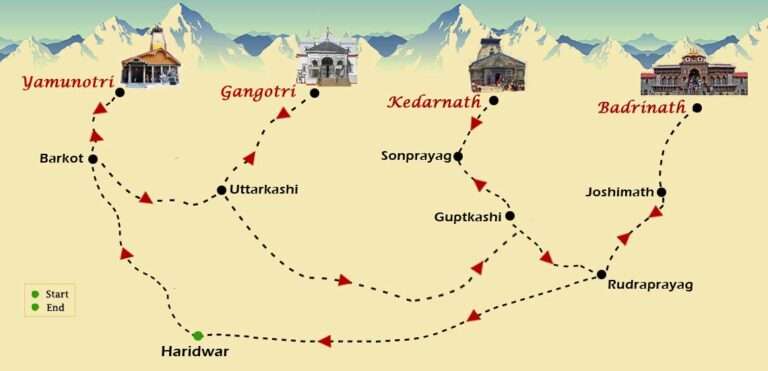
Detailed Itinerary:
Day 01: Delhi – Haridwar
Arrive at Delhi Airport and proceed to Haridwar. Evening visit Mansa Devi Temple & Ganga Aarti at Har Ki Pauri. Overnight stay at Haridwar. An Evening at Ganga aarti Haridwar: The Ganga Aarti in Hardwar’s Har-ki-Pauri is one of the famous rituals in India. It starts at around 6.30pm aftersunset, with large crowds gathered around both the banks of a canal that carries the waters of Ganges. Loud speakers blare songs in praise of Ganga Maiya and Shiva. The time of Aarti sees a bustle of activity on the ghats a pack of diya comes fully equipped and is self-sufficient! It has a wick lamp surrounded by flowers It lasted for around 30 min
Day 02: Haridwar – Barkot (210kms/7-8Hrs) Height: 1352 MTS
Early morning drive to Barkot via Dehradun & Mussourie. Enroute visit Kempty Fall and later continue drive to Barkot, Check in Hotel. O/N Barkot.
Day 03: Barkot – Yamunotri – Barkot {42kms Drive/5 Kms Trek (One Side)} Height: 3165 MTS
Early morning after breakfast (packed breakfast), drive to Jankichatti/ Phoolchatti & trek from here to Yamunotri (6kms) (Either by walk or by horse or by Doli at own cost). After taking bath in Jamunabai Kund’s warm water and cook rice by packing it in a cloth and dipping it in the hot water of the hot kund. Pilgrims take this cooked rice home as “Prasad”. Having Darshan of “Yamunaji” return to Jankichatti by trek. Overnight stay at Barkot.
Hanuman Chatti: The confluence of Hanuman Ganga & Yamuna River.
Yamunotri Temple: Maharani Gularia of Jaipur built the temple in the 19th Century. It was destroyed twice in the present century and rebuilt again.
Surya Kund: There are a Number of thermalsprings in the vicinity of the temple, which flows into numerous pools. The most important of these is Surya Kund.
Divya Shila: A rock pillar, worshipped before entering the Yamunotri Temple.
Yamunotri– Yamunotri is situated in the western region of the Garhwal Himalayas and is at a height of 3,235 meters above sea level. Yamunotri isthe source of the river Yamuna.The shrine of Yamunotri is located on the Bandar Poonch peak.
Day 04: Barkot – Uttarkashi (100 Kms/4Hrs) Heights: 1158 MTS
Morning after leisurely breakfast, drive to Uttarkashi. Check into the hotel arrival in Uttarkashi. Evening visit Kashi Vishwanath Temple in Uttarkashi. Overnight stay at Uttarkashi.
Uttarkashi: Situated at the bank of river Bhagirathi. The temple of Lord Vishwanath is located here where a massive iron trident is erected. The other important temples situated here are Ekadash Rudra, Bhairav, Gyaneshwar and Goddess Kuteti Devi.
Day 05: Uttarkashi – Gangotri – Uttarkashi (120kms/5 hrs each side) Heights: 3142 MTS
Early morning (packed breakfast) drive to Gangotri(3048 mts), enroute at Gangnani take a holy dip in Garam Kund, have bath drive to Gangotri via beautiful Harsil Valley. Harsil is famous for its nature beauty and for the majestic views of the Deodar trees and mountains. On arrival at Shree Gangotri, take a holy dip in the sacred river Ganges which is also called Bhagirathi at its origin. Perform Pooja and Darshan, after that relax forsome time in the lovely surroundings. Later drive back to Uttarkashi. Overnight stay at Uttarkashi.
Gangotri- Gangotri is the place high in the Garhwal Himalayas from where the holy Ganges originates. According to the legend, it was here the Ganga descended on the earth, when Lord Shiva released the mighty river from the locks of his hair. The temple of Gangotri, dedicated to Goddess Ganga stands on the bank of the river
Day 06: Uttarkashi – Guptkashi/Sitapur (290kms/8-9hrs) Heights: 1319 MTS
Morning after breakfast, drive to Guptkashi via Moolgarh & Lambgoan. Enroute you can see the beautiful river
Mandakini at Tilwara. The Mandakini river comes from Kedarnath, drive alongside the river to reach Guptakashi, visit Ardh Narishwar Temple in Guptakashi. Check into the hotel arrival in Guptakashi. Overnight stay at Guptakashi.
Day 07: Guptkashi/Sitapur – Shri Kedarnath ji {32kms Drive/19kms Trek (One Side)} Heights: 3584 MTS
Morning after breakfast drive to Gaurikund, Trek start from Gaurikund to Shri Kedarnath ji (3584 mts) on foot or on by pony / Doli. Yatra members should carry personal medicines, heavy woolen, tolietteries and clothes for an overnight halt at Shri Kedarnath. Check in Hotel. After freshening up, visit Shri Kedarnath ji Temple & perform Pooja. In the evening also visit Adi Shankaracharya Samadhi behind the Temple. Overnight stay at Kedarnath hotel.
Shri Kedarnath- is a majestic sight, standing in the middle of a wide plateau surrounded by lofty snow Covered peaks. The temple of Kedarnath, located at a height of 3,581 mts, stand at the head of the Mandakini river. The present temple, built in the 8th century by Adi Shankaracharya, stands Adjacent to the site of an earlier temple built by the Pandavas. The inner walls of the assembly hall are decorated with figures of various deities and scenes from mythology. Outside the temple door a large statue of the Nandi Bull stands as guard. It is said that devotees who die here become one with Shiva himself.
Day 08: Shri Kedarnath – Guptkashi/Sitapur {19kms (trek) / 32kms 6hrs} Height: 3584 MTS
On this day we will stay in Sitapur to keep a buffer time in hand to handle any last moment delay because of bad weather or any technical or medical reason. This is best way to arrange an itinerary or program for both trekkers and flyers to Shri Kedarnath Ji. In lack of geographical knowledge and climate conditions of this divine land some passengers or some travel agents or tour operators use to keep neck to neck to program for 02 nights in Kedarnath Ji region this always create problem and they themselves use to disturb their further program. You should cover the sight-sing or Darshan of Shri Triyugi Narayan Temple (Optional and Chargeable Extra) for maximum use of this day if we stay in Guptkashi/Sitapur.
Day 09: Guptkashi/Sitapur- Shri Badrinath (220kms/7Hrs) Heights: 3133 MTS
Morning after breakfast, drive to Shri Badrinath. Check in to the hotel arrival in Shri Badrinath. Pilgrims after having a bath in the Taptkund have the Darshan of Badrivishal & Aarti in evening. Brahamakapal is significant for Pinddan Shraddh of ancestors (Pitrus). There are other interesting sightseeing spot like Mana, Vyas Gufa, Maatamoorti, Charanpaduka, Bhimkund and the “Mukh” of the Saraswati River. Just within the three kms of Badrinathjee. Overnight stay at Shri Badrinath.
Shri Badrinath- Shri Badrinath is one of the most important of all the four(Char) Dhams in India. This temple located between Nar & Narayan mountain ranges and in the shadow of Nilkantha peak at the height of 3,133 mts. It is the most popular of Vishnu pilgrimages among the five Badries, also known as Vishal Badri.
Tapt Kund: Natural thermal springs on the bank of the river Alaknanda, where it is customary to bathe before entering the Badrinath temple.
Narad Kund: A recess in the river, near Tapt Kund, forming a pool from where the Badrinath idol was recovered.
Mata Murty Temple: Devoted to the mother of Sri Badrinathji. Other important templesinclude SeshNetra Temple, Urvashi Temple and Charanpaduka
Mana Village: Inhabited by an Indo-Mongolian tribe, it is the last Indian village before Tibet.
Bhim Pul: On the other side of Mana village, a massive rock forming a natural bridge lies Over the roaring Saraswati River. It presents a spectacular view of water thundering down through the narrow passage under the rock and is believed to have been placed there by Bhim, the second eldest among the five Pandava brothers.
Vyas Gufa (cave): Near Mana Village, this is a rock-cave where Ved Vyas is believed to have composed the Mahabharata and the pauranic commentaries.
Day 10: Shri Badrinath – Pipalkoti/Joshimath/Srinagar/Rudraprayag (77/46/187/155 Kms 7-9 hrs) Heights: 895 MTS
Morning after breakfast, driver for Rudraprayag via Pipalkoti. Visit on the way Narsingh Temple in Joshimath later drive back to Rudraprayag via Joshimath. Check into the hotel arrival in Pipalkoti/ Joshimath/ Srinagar/ Rudraprayag. Overnightstay at Pipalkoti/Joshimath/ Srinagar/ Rudraprayag.
Rudraprayag: One of the holy prayag of five famous prayag of Uttarakhand. Confluence of River Alaknanda and Mandakini.
Narsingh Temple: This is an ancient temple of Lord Vishnu in Narsingh Avtar and main temple of Joshimath. When Badrinath temple remains closed during winter every year, one idol of Lord Badri is brought to Narsingh temple and worshiped for six months.
Day 11: Pipalkoti/Rudraprayag – Haridwar (165kms/5-6hrs)
Early morning, after breakfast drive back to Haridwar. Enroute visit Laxman Jhulla, Ram Jhula, etc. On arrival check in hotel.
Day 12: Haridwar – Delhi Station / Airport Drop
Early morning, after breakfast drive back to Haridwar. Enroute visit Laxman Jhulla, Ram Jhula, etc. On Arrival Haridwar, drop at Hotel/Railway Station.